Cube Tap Sort
Tripledot Studios LimitedPuzzle
4.7706.00 Reviews
- Version
- 1.5.6
- Installs
- 500.00K
- Age Rating
- Everyone
Screenshots
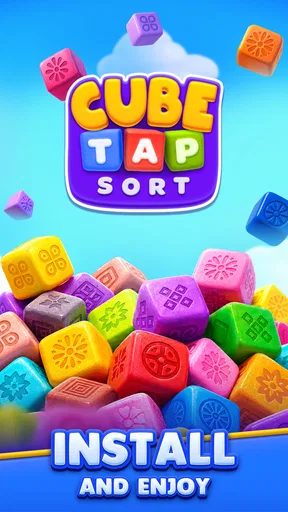
Our Review of Cube Tap Sort
 Analysis by Appyee
Cube Tap Sort is the kind of puzzle game I reach for when I want something easy to understand but still capable of making me pause. Its central idea is straightforward: tap blocks, organize matching colors, and work through three-dimensional arrangements. That simplicity is its biggest strength, because I can start playing almost immediately without learning a complicated rule set or committing to a long session.
My overall impression is positive, with one important qualification. This is best viewed as a compact, casual brain teaser rather than a deep puzzle system. It works especially well for short breaks, quiet evenings, or anyone who enjoys visual sorting challenges. Players looking for a long-form strategy game, a story, or highly demanding logic problems may find its format too light. For the right audience, though, the clean color-based concept makes it a pleasant way to give attention and spatial thinking a small workout.
How the color-sorting puzzles feel in practice
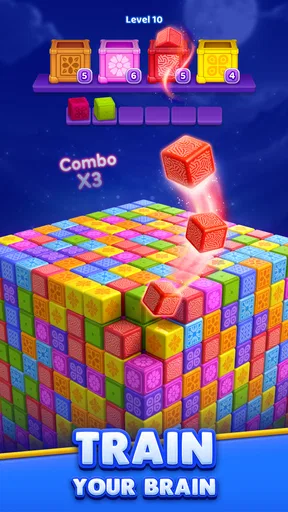
The game belongs to the puzzle category and is developed by Tripledot Studios Limited. The first few moments are deliberately approachable: the colored blocks communicate the objective visually, so I do not need a lengthy explanation before making my first move. That matters on a phone, where a game often has only a few seconds to prove that it is worth opening.
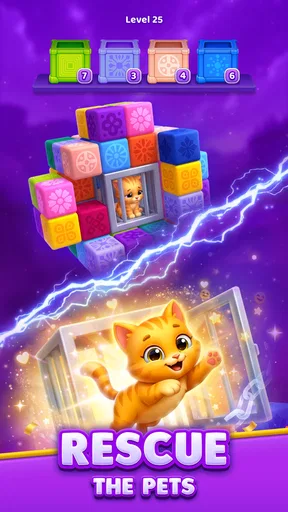
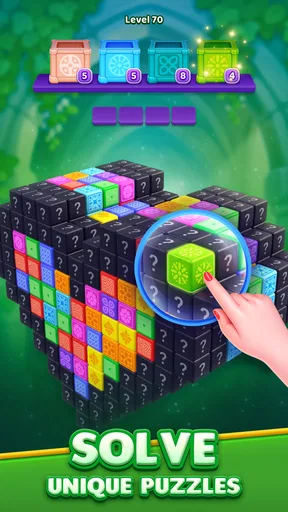
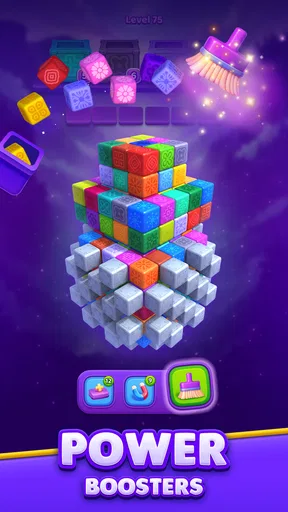
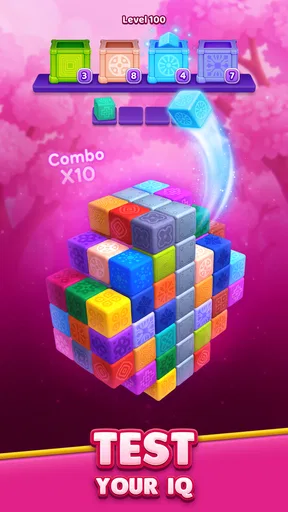
The three-dimensional presentation gives the familiar sorting idea a useful twist. I am not simply looking at a flat row of colored pieces. I have to consider what is visible, what may be positioned behind another block, and whether a tap now will make the next arrangement easier or more awkward. Even when the rule is simple, the perspective encourages me to slow down and inspect the whole structure before acting.
The most satisfying part is planning one move beyond the obvious match. A color may be ready to combine, but tapping immediately is not always the best choice if that action blocks access to another useful piece. I found that the game becomes more interesting when I stop treating every available match as automatically correct and instead think about the order in which the structure should be cleared.
This creates a gentle learning curve. At first, I can rely on recognition and quick taps. Later, I naturally begin scanning the arrangement, identifying groups that need space, and reserving a convenient position for pieces that are harder to reach. The game does not need complicated vocabulary or elaborate mechanics to create that small shift from reaction to planning.
Why the three-dimensional layout matters
Many color-matching puzzles are essentially flat exercises. Their challenge comes from speed, pattern recognition, or choosing among visible options. Here, the cube-like layout makes visibility part of the problem. I have to rotate my attention around the arrangement even when the interaction itself remains simple. That gives each puzzle a little more physical presence than a standard grid.
There is also a useful difference between seeing a color and understanding its role. A block can look like an obvious target, yet its position may make it strategically inconvenient. I learned to check nearby spaces first rather than tapping the most attractive color on the screen. This is a small habit, but it is one of the reasons the game feels more thoughtful than its short description suggests.
For younger players and casual users, the visual language should be easy to grasp. The content rating is Everyone, which fits the nonviolent, accessible nature of the experience. For adults, the same clarity makes it suitable for a quick mental reset. I can play without sound or a large time investment and still understand what the current puzzle is asking me to do.
A good fit for short, interrupted sessions
One realistic use case is a commute or waiting-room break. I might open the game while waiting for an appointment, complete a few sorting challenges, then put the phone away without feeling that I have abandoned a complicated campaign. That stop-and-start quality is valuable for a mobile puzzle. It does not demand the uninterrupted concentration that a longer strategy title often needs.
It also works after work when I want something more engaging than passive scrolling but less demanding than a competitive game. The color grouping gives my attention a clear target, while the compact format keeps the activity from becoming a major commitment. I would not describe it as a substitute for a full logic puzzle book, but it is a convenient middle ground between idle tapping and serious problem solving.
The current version is 1.5.6, and the game runs on Android 7.1 or later. That broad compatibility makes it practical for people who are not using a recent phone. I still recommend checking how comfortably the three-dimensional board displays on an older or smaller screen, because visual separation is important to this particular style of puzzle.
Where it stands against familiar alternatives
Compared with a traditional match-three game, this experience is less about creating chains and more about controlling order and space. There is no need to chase a rapidly changing board in the same way. That makes it calmer and more deliberate, although players who enjoy explosive combos may miss that sense of momentum.
Compared with classic block-fitting games, the objective is also different. The main challenge is not arranging falling shapes or filling lines. Instead, I am interpreting a three-dimensional collection and deciding which color relationship to resolve first. That distinction makes it appealing to people who like sorting and organization more than reflex-based play.
Compared with nonogram or Sudoku-style puzzles, Cube Tap Sort is easier to enter and more visual. I do not need to maintain a written grid or remember a large set of numerical constraints. The trade-off is depth: a dedicated logic-puzzle app will usually offer more complex deduction and a stronger sense of mastery over time. This game favors accessibility and immediate feedback over intricate systems.
That comparison helped clarify who should choose it. If I want a relaxing visual puzzle that can be understood at a glance, this is a sensible option. If I want carefully layered deductions, formal difficulty progression, or a puzzle that I can analyze for a long evening, another category would probably serve me better.
Strengths, friction, and the audience I would recommend
The strongest evidence in its favor is how quickly the core interaction becomes satisfying. Tapping a block is simple, but arranging taps in the right sequence gives the action purpose. The game rewards looking ahead without requiring expert knowledge. I can improve through observation rather than memorizing obscure rules, which makes each small success feel earned.
Another strength is the balance between visual clarity and mental involvement. The colors make the objective readable, while the three-dimensional structure prevents the experience from becoming completely automatic. I often begin with a quick scan, then notice that a seemingly easy move could create a less convenient board. That moment of reconsideration is where the puzzle earns its place as a brain teaser rather than a purely decorative matching game.
The free entry point is also important. Cube Tap Sort is free to download, so I can test whether its rhythm suits me without paying before understanding the experience. There are in-app purchases ranging from $1.99 to $99.99 per item, which is a wide span. I would approach those purchases carefully and decide first whether the basic loop remains enjoyable on its own. A casual puzzle should not feel like it needs extra spending to justify opening it.
That is one of the meaningful limitations. The simplicity that makes the game welcoming can also limit its appeal after the novelty of sorting wears off. I would not choose it expecting a story, character development, competitive depth, or a broad set of unrelated puzzle modes. Its identity is focused, and that focus is helpful at first but may feel narrow to players who need constant variety.
Another possible friction point is the reliance on color and perspective. The visual design is central to understanding the board, so anyone who has difficulty distinguishing similar shades may find some arrangements less comfortable. Likewise, a small screen can make a three-dimensional cluster harder to inspect than a flat puzzle. I would recommend increasing screen brightness and playing with the phone held steadily when a board feels visually busy, rather than rushing taps based on a partial view.
My most useful practical tip is to pause before clearing the first obvious group. I look for pieces that are tucked behind or surrounded by other colors and ask which move will open the most useful space. This prevents the common mistake of spending a convenient move too early. A second tip is to treat empty room as a resource: a clean area can make later sorting much easier, so I avoid filling every available position just because a match is visible.
A third insight is that the game rewards a different mindset from ordinary speed matching. I get better results when I divide the board into small regions, identify the most constrained color, and then work outward. This is especially helpful when several colors appear equally available. Rather than choosing the group that looks easiest, I choose the one whose position gives me the fewest future options.
These habits also explain why I would not recommend the game to everyone. Players who dislike repeating a focused mechanic may become bored, and those who want a demanding test from the first minute may find the opening too gentle. It is also not the right choice for someone seeking an offline-style puzzle book replacement with extensive written logic. The visual sorting format is the point, and there is no reason to pretend it offers something broader.
On the other hand, it is a strong match for people who enjoy tidy visual systems, organizing objects, and making small plans. It can suit a parent looking for an accessible casual game, a commuter wanting short sessions, or an adult who prefers calm concentration over fast competition. The Everyone age rating supports that broad approach, while the straightforward controls reduce the barrier for someone who does not regularly play mobile games.
With an average rating of 4.7 from around 28 thousand ratings and more than 500 thousand installs, it has clearly attracted a substantial audience. I treat those figures as a sign that the basic idea connects with many players, not as proof that every person will enjoy it. The game’s appeal depends heavily on whether sorting colored 3D pieces feels relaxing or repetitive to the individual player.
There is also a practical question about value. Since the game is free, it is easy to experiment with it during a spare moment. I would play several sessions before considering any optional purchase, paying attention to whether I am enjoying the decisions or merely tapping through habit. That approach is particularly sensible when optional items can cost as much as $99.99, because the value of a casual puzzle is personal and depends on how often it becomes part of a routine.
My final verdict is that Cube Tap Sort succeeds because it keeps its promise focused without making the interaction empty. It gives me a clear visual task, adds just enough spatial planning to prevent automatic play, and fits naturally into short mobile sessions. Its weaknesses are equally clear: the mechanic may not provide enough variety for long-term puzzle enthusiasts, and the three-dimensional color presentation may not suit every screen or player.
I would recommend it to a friend who wants a free, approachable sorting game for brief mental breaks. I would suggest a more advanced logic title to someone who wants intricate deduction, and a match-three game to someone who mainly wants fast combos and constant visual action. For everyone in between, this is a polished little puzzle experience worth trying, especially when the goal is to slow down, inspect a colorful structure, and make the next tap with a bit more thought.
Verdict
Strengths of Cube Tap Sort
- Simple tap controls make the sorting mechanic easy to learn.
- Short levels are convenient for quick gaming sessions.
- Colorful cube designs make the board easy to read.
- Gradual challenges help introduce new puzzle mechanics.
- Offline play is useful when you have no internet connection.
Limitations of Cube Tap Sort
- Later puzzles can feel repetitive once the core mechanic is familiar.
- Some levels may depend more on trial and error than planning.
- Limited variety in objectives can reduce long-term replay value.
- Small screens may make crowded cube arrangements harder to inspect.
- Ads may interrupt play, depending on the version and device.
Other Releases by Tripledot Studios Limited
View All
Woodoku - Wood Block Puzzle
Puzzle4.2

Get Color - Water Sort Puzzle
Puzzle4.8


Nut Sort: Color Sorting Game
Puzzle4.8
Similar Picks in This Category
View All
Block Blast!
HungryStudio4.8

Braindom: Brain Games Test
Lahana Game Studio4.6

AMAZE!
CrazyLabs LTD4.6

Sudoku - Classic Sudoku Puzzle
Oakever Games4.7

Art Puzzle - Puzzle Games
Easybrain4.8

Amaze GO!
Oakever Games4.9
Frequently Asked Questions
What is Cube Tap Sort and how do you play it?
Cube Tap Sort is a casual puzzle game based on organizing and matching colored cubes. You usually tap or move pieces to group identical colors, clear completed sets, and solve each level within the available space or move limit. The controls are simple to learn, but later stages require planning because one careless move can block useful positions and make the puzzle much harder to complete.
Is Cube Tap Sort free to download and play?
Cube Tap Sort can generally be downloaded for free, allowing players to try the core sorting puzzles without paying upfront. However, the game may include optional advertisements, rewarded videos, extra lives, hints, or in-app purchases depending on the version and platform. Before downloading, it is worth checking the store listing for current pricing, advertising details, and any available purchase options.
Does Cube Tap Sort work without an internet connection?
Many of the basic levels in Cube Tap Sort can be played offline once the game has been installed, which makes it suitable for short sessions while traveling or when mobile data is unavailable. Nevertheless, internet access may be required for advertisements, daily rewards, cloud features, updates, or in-app purchases. Offline behavior can vary between versions, so testing it after installation is recommended.
Is Cube Tap Sort suitable for children and casual players?
Cube Tap Sort is designed to be approachable, with straightforward tapping controls and colorful visual feedback that casual players can understand quickly. It does not usually require fast reflexes, making it suitable for relaxed puzzle sessions. Parents should still review the store rating, advertising policy, and in-app purchase settings, especially if children will play, because optional purchases or third-party ads may be present.
Does Cube Tap Sort become difficult, and are hints or boosters available?
The early Cube Tap Sort levels are generally easy enough to introduce the sorting mechanics, but the challenge increases as more colors, tighter spaces, or additional restrictions are introduced. Depending on the version, players may receive hints, undo actions, boosters, or extra attempts when they get stuck. These tools can help, although some may be limited, earned through play, or offered through advertisements or purchases.
Play our best games!


